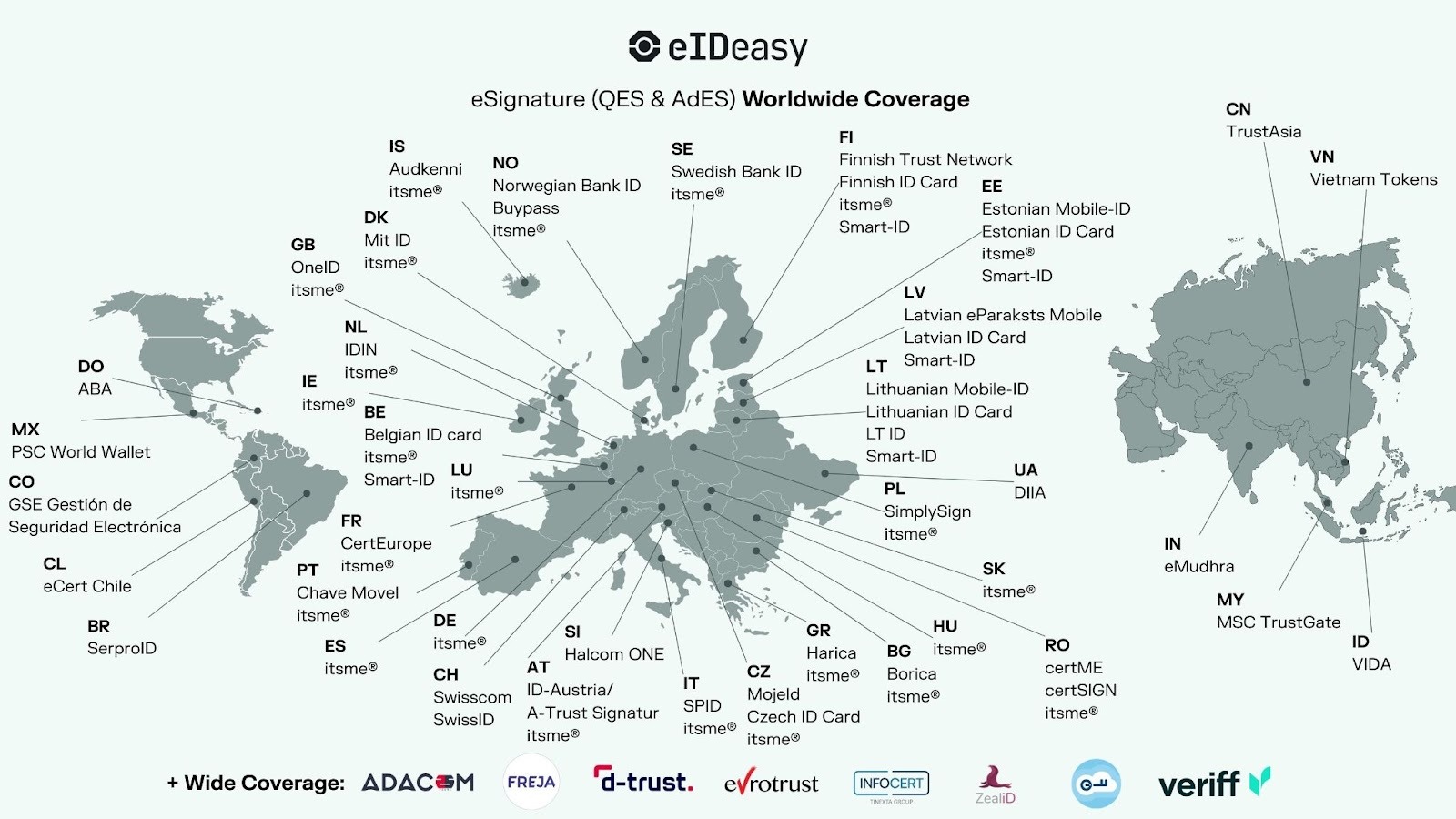
The ability to near instantly establish digital trust between organisations and their online audiences is not universal but is becoming more prevalent and certainly not the domain of the world's leading economies. Electronic identification (eID) schemes are proving to be far more than just a digital convenience; they are essential instruments for secure, efficient, and trustworthy user identity. There are an estimated 165 such schemes currently, with new services being launched all the time. To bring that home, the Financial Times suggests digital ID systems like those in Estonia and Italy could save the UK around 2% of GDP annually by reducing benefits fraud and improving tax collection, possibly worth £2 billion per year.
eID adoption is advancing rapidly across regions:
| Region | Countries | Adoption Rate |
|---|---|---|
| Nordics and Benelux | Norway, Sweden | Close to 90% |
| Strong European uptake | Belgium, Finland, Baltic states | 60 to 70% |
| United Kingdom | UK | Around 75% (via bank checks) |
There are, as with any innovation, drawbacks and detractors. Concerns over an ever-more monitored and surveilled society persist. Ill-informed political objectives cloud their intended use and adoption schedule, as repeated British Prime Ministers' ill-judged announcements have proven.
What is an eID Scheme?
A national eID scheme is a government-run system that provides citizens and residents with a secure digital identity, often linked to a physical ID card or mobile solution. It enables people to authenticate themselves online, access public and private services, and carry out secure transactions such as banking, healthcare, or tax filing.
Expansion of these core citizen concepts can be seen in Open Banking checks, Mobile Driver's Licences and the next step in re-usable credentials and wallets, whether public or private.
Citizens with an eID can verify their identity by using unique digital credentials, such as a smart card, mobile app, or biometric check, issued by the government to securely authenticate themselves online.
Key benefits supported by real-world evidence
1. Interoperability & Cross-Border Reach
eIDAS-enabled schemes enable mutual recognition of national eIDs across the EU, allowing citizens to access services in other Member States using their own government-issued IDs. This cuts down on red tape, redundancy, and time-intensive manual checks.
2. Stronger Security & Trust
eID systems are designed with strong Levels of Assurance (LoA), significantly lowering the risk of identity theft and fraud. For SMEs, combining eID with trust services has notably reduced administrative burden and operational costs, whilst enabling safer electronic transactions.
3. Widespread Adoption & Convenience
Adoption varies by country, but some national eIDs have already achieved remarkable penetration:
| eID Scheme | Country | Active Users | Usage Frequency |
|---|---|---|---|
| SPID | Italy | 33.5 million | – |
| DINe | Spain | 38 million | – |
| itsMe | Belgium | 7 million | – |
| Icelandic eID | Iceland | 95% of eligible population | 20+ times per month |
Iceland demonstrates the highest penetration, with 95% of the eligible population possessing an active eID and using it more than 20 times per month across public and private services, acting effectively as a single sign-on solution.
4. Faster, No-Code Deployments with High Conversion
Platforms like Zenoo and eID Easy enable compliance and growth teams to deploy fully branded, regulation-compliant identity workflows in days, not months. By integrating dozens of public and private eID methods out of the box, they dramatically reduce friction, boost conversion, and ensure flows remain aligned with evolving EU digital identity standards.
Further concerns and evidence from early adopting nations show data breaches have led to citizens being put at risk by their own governments.